ELECTRONIC_PROJECTSCIRCUIT • DESIGN • BUILD
Connecting Circuits...

🤖🤖
No achievements listed yet.

A Laser Security Alarm System is a simple electronic project used to detect intruders. The system consists of a laser source, an LDR sensor, a transistor, a resistor, an LED, and a buzzer. The laser beam continuously falls on the LDR sensor. When the beam is interrupted by a person or an object, the resistance of the LDR changes. This change activates the transistor, which turns on the buzzer and LED to give an alarm signal. This project demonstrates the practical use of sensors and electronic switching devices in security applications. It can be used in homes, offices, and educational electronics projects.
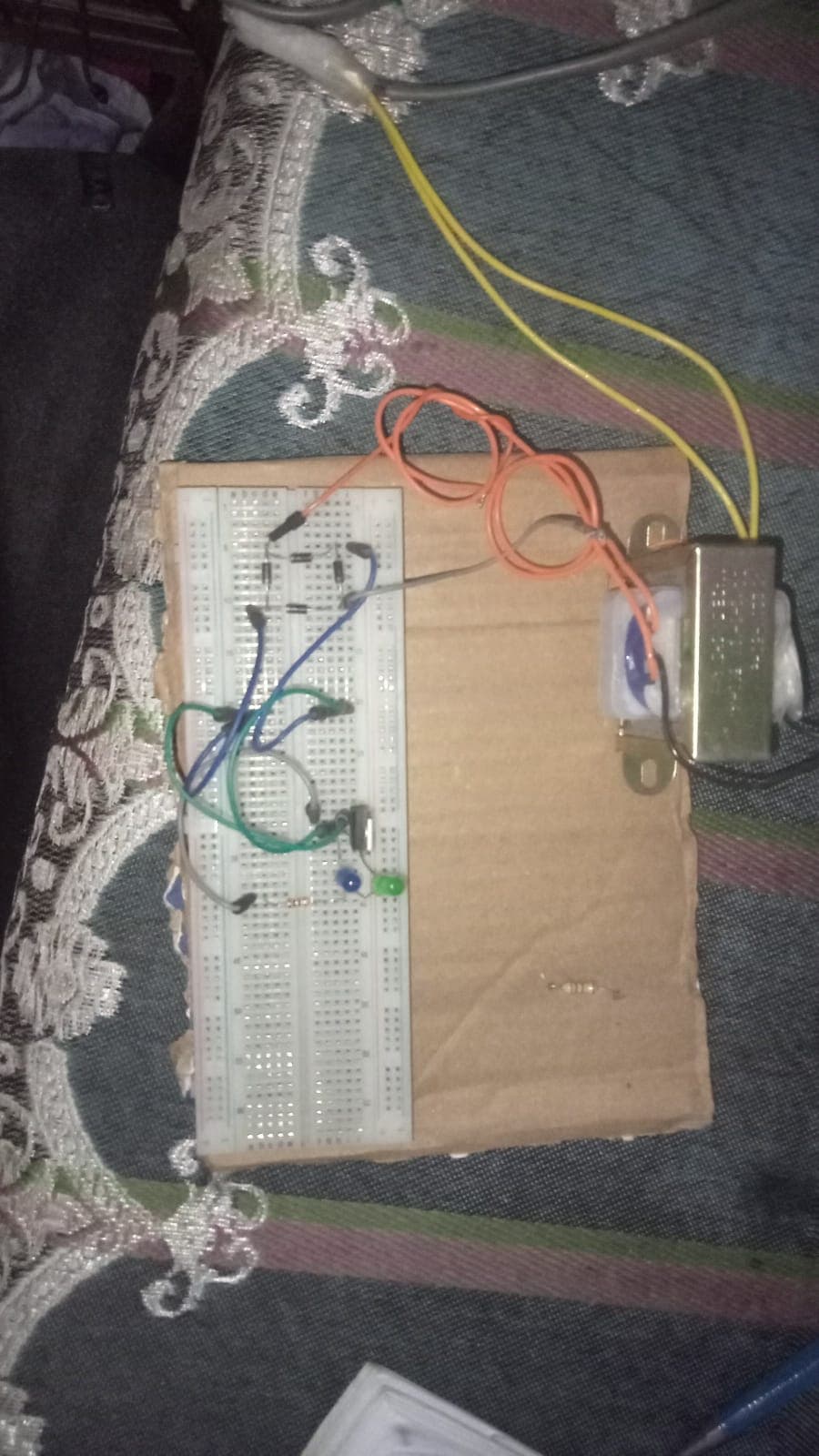
Full-Wave Bridge Rectifier Circuit Project Description This project demonstrates a Full-Wave Bridge Rectifier circuit used to convert Alternating Current (AC) into Direct Current (DC). The circuit uses a transformer to reduce the AC voltage and four diodes connected in a bridge configuration to rectify the input signal. An LED is used as an indicator to show the presence of the DC output. Components Used - Transformer - Four Rectifier Diodes - LED - Resistor - Breadboard - Connecting Wires Working Principle The transformer supplies an AC voltage to the bridge rectifier circuit. During the positive half-cycle of the AC input, two diodes conduct current, while during the negative half-cycle, the other two diodes conduct. As a result, the current flows through the load in the same direction during both half-cycles, producing a pulsating DC output. The LED lights up to indicate that the circuit is functioning properly. Applications - DC Power Supplies - Battery Charging Circuits - Electronic Devices Requiring DC Voltage - Educational and Laboratory Experiments Conclusion The Full-Wave Bridge Rectifier is an efficient circuit for converting AC voltage into DC voltage. It utilizes both halves of the AC waveform, resulting in a higher average output voltage and better efficiency compared to a half-wave rectifier.