ELECTRONIC_PROJECTSCIRCUIT • DESIGN • BUILD
Connecting Circuits...
Discover innovative projects and technical excellence from the next generation of electronics engineers.
The Automatic Street Light System is an intelligent lighting solution designed to automatically control street lights based on the ambient light levels. Using a Light Dependent Resistor (LDR) or similar sensor, the system detects changes in natural light throughout the day. When daylight falls below a certain threshold (such as during sunset or cloudy weather), the street lights are automatically turned ON. Conversely, when there is sufficient daylight (like during sunrise), the lights are turned OFF. This system helps in reducing electricity consumption, lowering maintenance costs, and improving energy efficiency by eliminating the need for manual switching. It can be particularly useful in urban as well as rural areas where street lighting is essential for safety and visibility during the night.
View ProjectA portfolio website showcasing innovative electronic projects by engineering students at Al-Azhar University, featuring circuit designs, simulations, and practical implementations.
A controllable RGB LED using Arduino allows you to change the color and brightness of the LED by adjusting the voltage sent to its red, green, and blue pins through PWM (Pulse Width Modulation). By writing simple code, you can create custom colors, color transitions, or even animations using the Arduino board.
This project is a motion-activated alarm system that utilizes a PIR (Passive Infrared) sensor to detect movement and trigger an alert. It integrates several key electronic components to ensure stable and reliable operation: 🔹 PIR Motion Sensor – Detects human motion through infrared radiation. 🔹 NPN Transistor – Functions as an electronic switch to control the relay. 🔹 Base Resistor – Limits current to the transistor’s base to ensure proper operation and protection. 🔹 Relay Module – Controls high-power loads such as the alarm buzzer. 🔹 Capacitor – Stabilizes the signal and reduces electrical noise and false triggers. 🔹 Buzzer (Alarm) – Emits an audible alarm when motion is detected. 🔹 Transformer + Voltage Regulator – Converts AC voltage and regulates it to a stable 5V DC for powering the entire circuit. Working Principle: When the PIR sensor detects motion, it sends a signal through the base resistor to the NPN transistor. The transistor switches on and activates the relay, which in turn powers the buzzer. The capacitor filters out noise, ensuring stable performance. The entire system is powered by a regulated 5V DC supply derived from a transformer and voltage regulator. PCB Design and Fabrication: The circuit was fully designed using KiCad, a professional PCB design tool. After the schematic was finalized and the PCB layout was created, the board was etched (chemical etching process), drilled, and all components were soldered manually to complete the hardware assembly. This project is a practical example of applying embedded electronics in security systems, smart automation, and sensor-based alert systems.
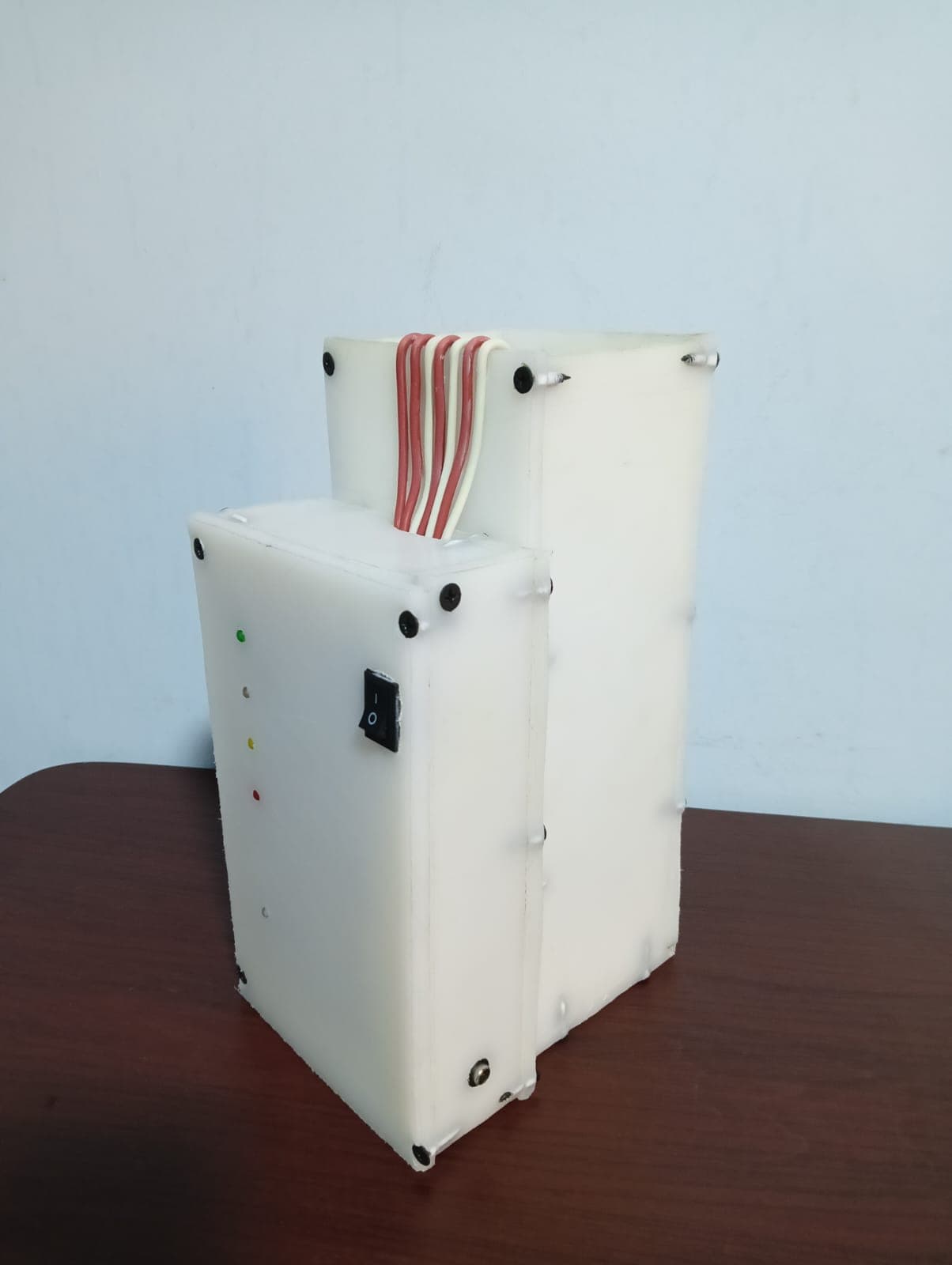
Basic Water Level Indicator is a simple project that shows the water level in a tank using LEDs. It helps people know if the water is low, medium, or full. This system uses sensors inside the tank and turns on lights to show the level. It is useful to avoid overflow or dry tanks at home or in small buildings.
As part of our university coursework, we developed a simple digital counter using an Arduino UNO and a 2-digit 7-segment display. The system is designed to count numbers interactively through two push buttons and display the result in real-time. Main Features: Increment Button: A short press increases the counter by 1. Decrement Button: A short press decreases the counter by 1. Long Press: Holding down the increment or decrement button causes the counter to change rapidly in the corresponding direction. Reset Function: Pressing both buttons simultaneously resets the counter to zero. Technical Overview: The circuit was built on a breadboard to allow flexibility and ease of testing. The Arduino was programmed using the Arduino IDE in C/C++, with functions modularized for clarity and reusability. Button debouncing was implemented in software to ensure reliable input detection. The 2-digit 7-segment display was interfaced directly with the microcontroller, with proper current-limiting resistors. Educational Value: This project demonstrates how basic electronic components and simple logic can be used to create a fully functional digital system. It introduces key concepts such as: Handling digital inputs from push buttons. Managing display output on a 7-segment module. Implementing long press detection and multi-button logic. Writing structured embedded C/C++ code for microcontroller applications. The result is a clean, responsive, and user-friendly digital counter—ideal for learning and demonstrating core embedded system principles.