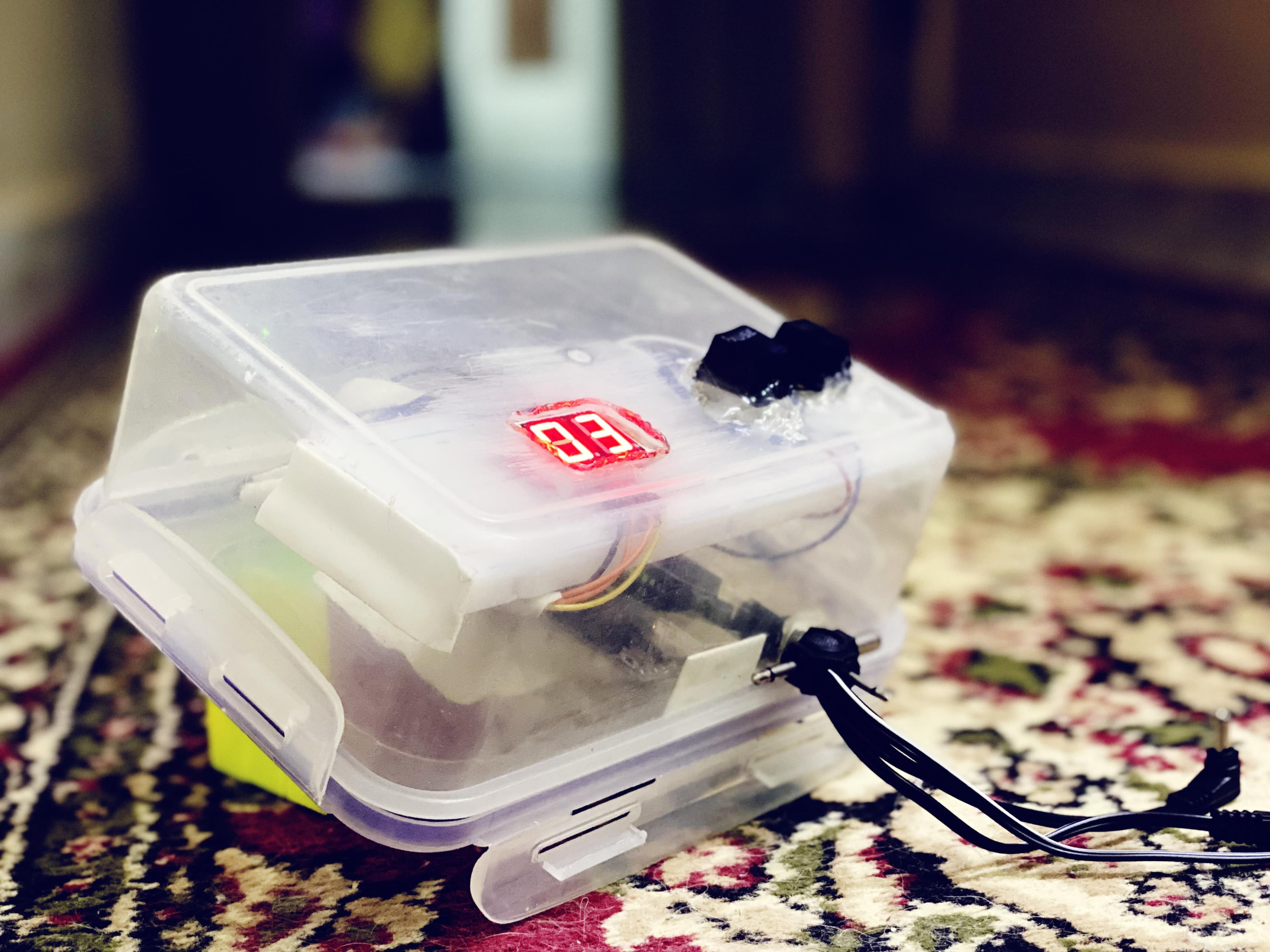
Simple Digital Counter Using Arduino UNO and 7-Segment Display
As part of our university coursework, we developed a simple digital counter using an Arduino UNO and a 2-digit 7-segment display. The system is designed to count numbers interactively through two push buttons and display the result in real-time.
Main Features:
Increment Button: A short press increases the counter by 1.
Decrement Button: A short press decreases the counter by 1.
Long Press: Holding down the increment or decrement button causes the counter to change rapidly in the corresponding direction.
Reset Function: Pressing both buttons simultaneously resets the counter to zero.
Technical Overview:
The circuit was built on a breadboard to allow flexibility and ease of testing.
The Arduino was programmed using the Arduino IDE in C/C++, with functions modularized for clarity and reusability.
Button debouncing was implemented in software to ensure reliable input detection.
The 2-digit 7-segment display was interfaced directly with the microcontroller, with proper current-limiting resistors.
Educational Value:
This project demonstrates how basic electronic components and simple logic can be used to create a fully functional digital system. It introduces key concepts such as:
Handling digital inputs from push buttons.
Managing display output on a 7-segment module.
Implementing long press detection and multi-button logic.
Writing structured embedded C/C++ code for microcontroller applications.
The result is a clean, responsive, and user-friendly digital counter—ideal for learning and demonstrating core embedded system principles.
Arduino, Digital Counter, 7-Segment Display, Embedded Systems, Electronics Project, Push Button, Arduino Uno, Hardware Project, Counter